Dead or Decaying Trees: When Should They Be Removed?
dead-decaying-trees

My Tree is Dead. Does That Mean It Has to Come Down? How Long Do I Have?

How do you know when a dead or decaying tree becomes a danger?

Lately, I’ve been visiting properties throughout Rhode Island and noticing something that keeps coming up: dead and declining trees in residential neighborhoods.

And homeowners are asking me the same question:

“The tree is dead. Do I need to take it down?”

The answer might surprise you.

Not every dead tree needs to be removed.

A dead tree standing in the middle of a field, far away from people, buildings, vehicles, or areas of activity, may pose very little risk. In fact, standing dead trees can provide valuable habitat for birds, insects, and other wildlife.

But that same tree standing over your driveway, home, garage, or along a busy street or bike path?

That’s a very different conversation.

It’s Not Just About the Tree. It’s About What’s Around It.

When evaluating a tree, one of the first things I consider is what could happen if a branch or the entire tree were to fail.

Could it strike a house? A parked car? A pedestrian? Someone enjoying their backyard?

The presence of a dead tree doesn’t automatically tell us how much risk it presents. We also need to consider its structural condition, the likelihood of failure, and whether people or property could be in its path.

What About Trees That Are Still Alive but Decaying?

Today, I visited a property with a large horse chestnut tree that provided a perfect example of why tree assessments are so important.

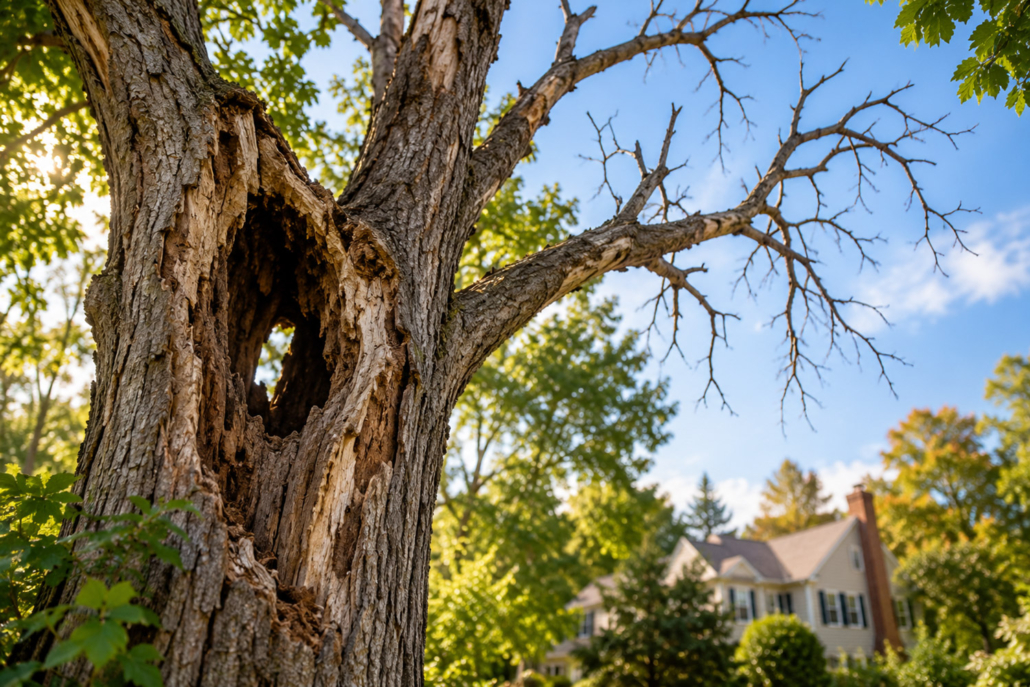
The tree had two major stems growing from the same trunk. One contained a significant cavity, with an opening that allowed you to see directly through part of the stem. The larger stem extended over the street.

That raises some important questions.

  • How much sound wood remains to support the tree?
  • Has decay compromised its structural integrity?
  • What could happen if the stem extending over the street were to fail?

A cavity doesn’t automatically mean a tree needs to be removed. Trees can survive for many years with hollow sections. But the size, location, and extent of decay can significantly affect their structural stability.

And when a large stem extends over a roadway, the consequences of failure deserve careful consideration.

Warning Signs Homeowners Shouldn’t Ignore

Some signs that a tree may need professional evaluation include:

  • Large dead branches, particularly over homes, driveways, or walkways.
  • Cavities, hollow sections, or areas of significant decay.
  • Mushrooms or fungal growth on the trunk or around the base.
  • Cracks or splits in major stems or branches.
  • Peeling or missing bark accompanied by dead wood.
  • Changes in the tree’s lean or signs of movement around the roots.

Not every one of these conditions means removal is necessary. But they are reasons to take a closer look.

So, When Should a Tree Be Removed?

There isn’t one answer that applies to every tree.

Sometimes pruning can reduce the risk. Sometimes a tree can be monitored or managed while preserving its benefits. Other times, removal is the most responsible recommendation.

The goal isn’t to remove every tree with a defect or every dead tree on a property.

The goal is to identify which trees present an unacceptable risk and address those conditions before someone gets hurt or property is damaged.

A Final Thought

Trees are valuable assets. They provide shade, beauty, environmental benefits, and character to our neighborhoods.

But they also change over time. They age, develop defects, experience storm damage, and eventually decline.

Not every dead or decaying tree needs to be removed, but every tree with potential structural concerns deserves thoughtful consideration.

A certified arborist can help homeowners understand the condition of their trees, evaluate potential risks, and make informed decisions about whether pruning, continued monitoring, or removal is the most appropriate course of action.

The goal isn’t simply to remove trees. It’s to preserve them whenever reasonably possible while protecting people and property.

If you’re questioning whether a dead or declining tree on your property should be removed, start with a professional assessment.

Because knowing when a tree doesn’t need to come down is just as important as knowing when it does.

When Drought Meets Hurricane Season in Rhode Island: What Your Trees May Be Telling You

arboreal-solutions-tree-assessment-08

As we move through September, many of us are beginning to notice the first hints of fall color across New England. A few yellow leaves here, some red or orange there—it can feel like an early preview of autumn.

But when a tree begins changing color well ahead of others around it, is fall really arriving early? Or is the tree showing signs of stress?

At Arboreal Solutions, this is something we pay attention to, especially after periods of drought. Early color can be part of a tree’s normal seasonal cycle, but it can also provide information about how that tree has handled the conditions of the current—and previous—growing seasons.

And as hurricane season continues, understanding that stress becomes even more important.

Is Early Fall Color Normal?

Not every tree changes color at the same time. Species, genetics, exposure to sunlight, temperature, and local growing conditions can all influence when fall color begins.

That means a tree showing some color in late summer or early fall isn’t automatically a cause for concern.

What catches our attention is a change from the tree’s usual pattern or a noticeable difference compared with similar trees nearby.

If one tree is turning color while surrounding trees of the same species remain green, if only one section of the canopy is changing, or if early color is accompanied by premature leaf drop, sparse foliage, or branch dieback, we may be seeing a stress response rather than simply an early autumn.

Drought Stress Doesn’t Always End When It Rains

One of the factors we’re continuing to watch is drought.

When soil moisture is limited, a tree has to function with fewer available resources. It may reduce growth, close the tiny openings in its leaves that regulate water loss, or shed leaves early as it attempts to conserve water.

A good rainfall can certainly help, but it doesn’t necessarily erase what happened during weeks or months of dry conditions.

Trees operate on a much longer timeline than we sometimes realize.

The Compounding Effect of Drought

A single difficult growing season can stress a tree. Repeated drought conditions year after year can create cumulative stress.

During prolonged or recurring drought, trees may have fewer resources available for growth, defense, and recovery. Fine roots responsible for absorbing water and nutrients can be affected. Growth may slow. A stressed tree can also become less capable of responding to additional environmental pressures.

The effects aren’t always immediately obvious.

A tree can remain standing and appear relatively healthy while its ability to tolerate the next stressor is gradually being reduced.

That’s why we look at tree health as a process rather than a snapshot.

Then the Wind Arrives

This becomes particularly relevant during hurricane season.

Strong winds place significant mechanical forces on trees. A healthy, structurally sound tree with an appropriate root system is generally better equipped to respond to those forces than a tree already dealing with compromised roots, dead or weakened branches, structural defects, disease, or environmental stress.

Drought does not automatically mean a tree will fail during a storm, and an early-changing leaf does not mean a tree is dangerous.

But multiple stressors can matter.

A tree that has endured repeated drought may then face saturated soil from heavy rain followed by high winds. Existing structural weaknesses can become more consequential when severe weather arrives. Dead branches, weak attachments, root problems, decay, and other defects may increase the potential for branch or whole-tree failure.

The question isn’t simply, “Did the wind knock the tree down?”

We also want to understand what condition the tree was in before the wind arrived.

Your Trees May Be Giving You Clues

September is a useful time to look closely at your landscape.

Pay attention to trees that seem different from those around them. Early color is one clue, but it should be considered alongside the rest of the tree.

Look for premature leaf drop, thinning canopies, dead branches, cracks or splits, mushrooms or other signs of decay near the trunk or root zone, changes in the soil around the roots, or branches that have changed position.

None of these observations alone tells us the entire story. Together, however, they can help an arborist understand how a tree is responding to its environment.

Proactive Tree Care Matters

At Arboreal Solutions, we believe tree care begins with understanding what the tree is telling us.

That means looking beyond a single symptom. We consider the tree’s species, structure, root environment, soil conditions, site history, exposure, and other stresses before making recommendations.

As hurricane season continues and drought remains a concern, now is a good time to take another look at the trees around your home or property—particularly mature trees near buildings, driveways, roads, gathering areas, or other places where people spend time.

Sometimes early fall color is simply fall arriving.

Sometimes it’s a tree telling us that the growing season has been harder than it looks.

Not sure what your trees need? Let’s start with a conversation. 

We take the time to understand your trees, your property, and your goals before recommending a course of action. 

Contact Arboreal Solutions to schedule a consultation and take the next step toward proactive, thoughtful tree care.

A Fresh Look for Arboreal Solutions

regina-costa-arborist

We’re excited to share the next chapter of Arboreal Solutions.

We’ve refreshed our website and introduced a new logo that reflects who we are today, the work we do, and our continued commitment to thoughtful, professional tree care and landscape stewardship.

As Arboreal Solutions has grown, so has the range of ways we help homeowners, property managers, HOAs, municipalities, and commercial clients care for the trees and landscapes that matter most to them.

Our updated website makes it easier to:

  • Learn about our services

  • Explore our approach to tree care and landscape stewardship

  • Understand how working with an experienced arborist can help you make informed decisions that protect the long-term health, beauty, and value of your property

Expertise for Every Stage of Tree Care

Healthy trees don’t happen by accident. They benefit from proper assessment, proactive care, and an understanding of how the tree, soil, surrounding landscape, pests, disease, weather, and other environmental factors work together.

At Arboreal Solutions, we provide services including consulting arborist services, tree risk assessments, precision pruning, plant health care, pest and disease management, tree planting, cabling and bracing, thoughtful removals, stump grinding, invasive species and vegetation management, and tick and mosquito treatments.

Our goal isn’t simply to address what’s happening with a tree today. Whenever possible, we want to help our clients understand why something is happening and develop an appropriate plan for the long-term health, safety, and beauty of their landscapes.

Autumn Is Coming—and Our Schedule Is Filling

While we’re celebrating our new website and logo, we’re also preparing for one of our busiest times of year.

Autumn tree care appointments are already filling quickly.

Fall is an important time to evaluate your trees, address pruning needs, identify potentially hazardous limbs, assess tree health, and prepare your landscape for the stresses of winter. Waiting until the first winter storm arrives isn’t the best time to discover that a tree needed attention.

If you’ve been thinking about having a tree evaluated or have work you’d like completed this fall, now is the time to get in touch and reserve your place on the schedule.

Explore and  See What’s New

Now that you are here, we invite you to browse and explore our services, and take a look at our new logo and refreshed online presence.

If you have questions about a tree or want to plan ahead for autumn tree care, reach out to us using our Contact Form. We’d be happy to learn more about your property, discuss your concerns, and help determine the right next steps.


© 2026 Arboreal Solutions, LLC