Dead or Decaying Trees: When Should They Be Removed?
My Tree is Dead. Does That Mean It Has to Come Down? How Long Do I Have?
How do you know when a dead or decaying tree becomes a danger?
Lately, I’ve been visiting properties throughout Rhode Island and noticing something that keeps coming up: dead and declining trees in residential neighborhoods.
And homeowners are asking me the same question:
“The tree is dead. Do I need to take it down?”
The answer might surprise you.
Not every dead tree needs to be removed.
A dead tree standing in the middle of a field, far away from people, buildings, vehicles, or areas of activity, may pose very little risk. In fact, standing dead trees can provide valuable habitat for birds, insects, and other wildlife.
But that same tree standing over your driveway, home, garage, or along a busy street or bike path?
That’s a very different conversation.
It’s Not Just About the Tree. It’s About What’s Around It.
When evaluating a tree, one of the first things I consider is what could happen if a branch or the entire tree were to fail.
Could it strike a house? A parked car? A pedestrian? Someone enjoying their backyard?
The presence of a dead tree doesn’t automatically tell us how much risk it presents. We also need to consider its structural condition, the likelihood of failure, and whether people or property could be in its path.
What About Trees That Are Still Alive but Decaying?
Today, I visited a property with a large horse chestnut tree that provided a perfect example of why tree assessments are so important.
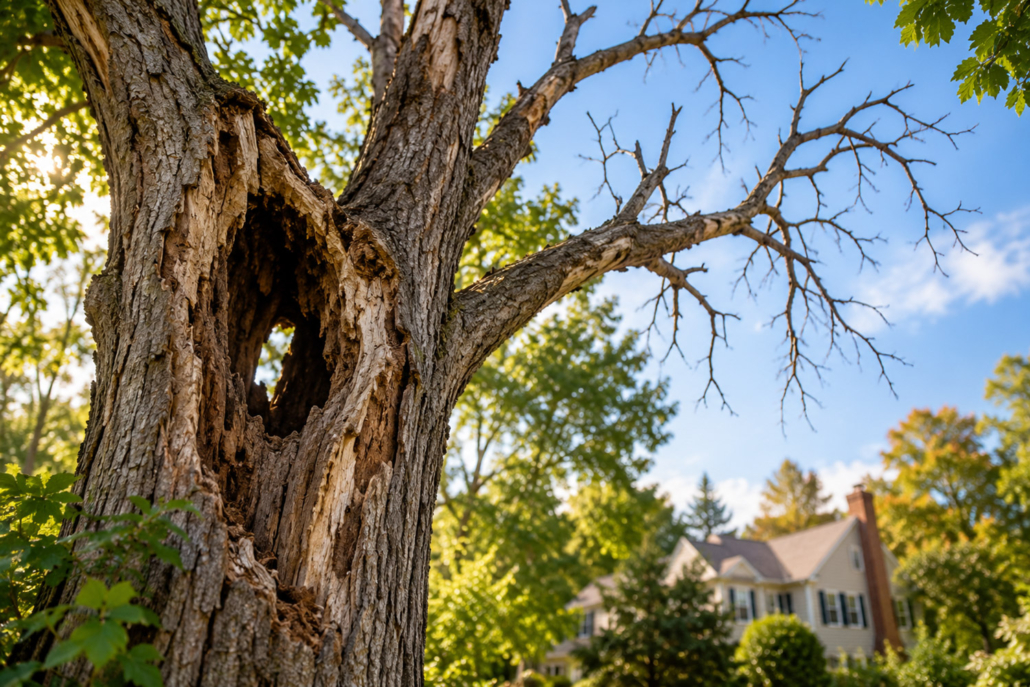
The tree had two major stems growing from the same trunk. One contained a significant cavity, with an opening that allowed you to see directly through part of the stem. The larger stem extended over the street.
That raises some important questions.
- How much sound wood remains to support the tree?
- Has decay compromised its structural integrity?
- What could happen if the stem extending over the street were to fail?
A cavity doesn’t automatically mean a tree needs to be removed. Trees can survive for many years with hollow sections. But the size, location, and extent of decay can significantly affect their structural stability.
And when a large stem extends over a roadway, the consequences of failure deserve careful consideration.
Warning Signs Homeowners Shouldn’t Ignore
Some signs that a tree may need professional evaluation include:
- Large dead branches, particularly over homes, driveways, or walkways.
- Cavities, hollow sections, or areas of significant decay.
- Mushrooms or fungal growth on the trunk or around the base.
- Cracks or splits in major stems or branches.
- Peeling or missing bark accompanied by dead wood.
- Changes in the tree’s lean or signs of movement around the roots.
Not every one of these conditions means removal is necessary. But they are reasons to take a closer look.
So, When Should a Tree Be Removed?
There isn’t one answer that applies to every tree.
Sometimes pruning can reduce the risk. Sometimes a tree can be monitored or managed while preserving its benefits. Other times, removal is the most responsible recommendation.
The goal isn’t to remove every tree with a defect or every dead tree on a property.
The goal is to identify which trees present an unacceptable risk and address those conditions before someone gets hurt or property is damaged.
A Final Thought
Trees are valuable assets. They provide shade, beauty, environmental benefits, and character to our neighborhoods.
But they also change over time. They age, develop defects, experience storm damage, and eventually decline.
Not every dead or decaying tree needs to be removed, but every tree with potential structural concerns deserves thoughtful consideration.
A certified arborist can help homeowners understand the condition of their trees, evaluate potential risks, and make informed decisions about whether pruning, continued monitoring, or removal is the most appropriate course of action.
The goal isn’t simply to remove trees. It’s to preserve them whenever reasonably possible while protecting people and property.
If you’re questioning whether a dead or declining tree on your property should be removed, start with a professional assessment.
Because knowing when a tree doesn’t need to come down is just as important as knowing when it does.
