
Do you ever ask yourself questions like: Why does my tree grow too fast and then look stressed? Why do we prune this tree every year? Why does this tree keep failing in storms? Why does this tree look thin even though it’s growing like crazy?
Then you may want to listen up and learn about why plant growth regulators (PGRs) may be right for you.
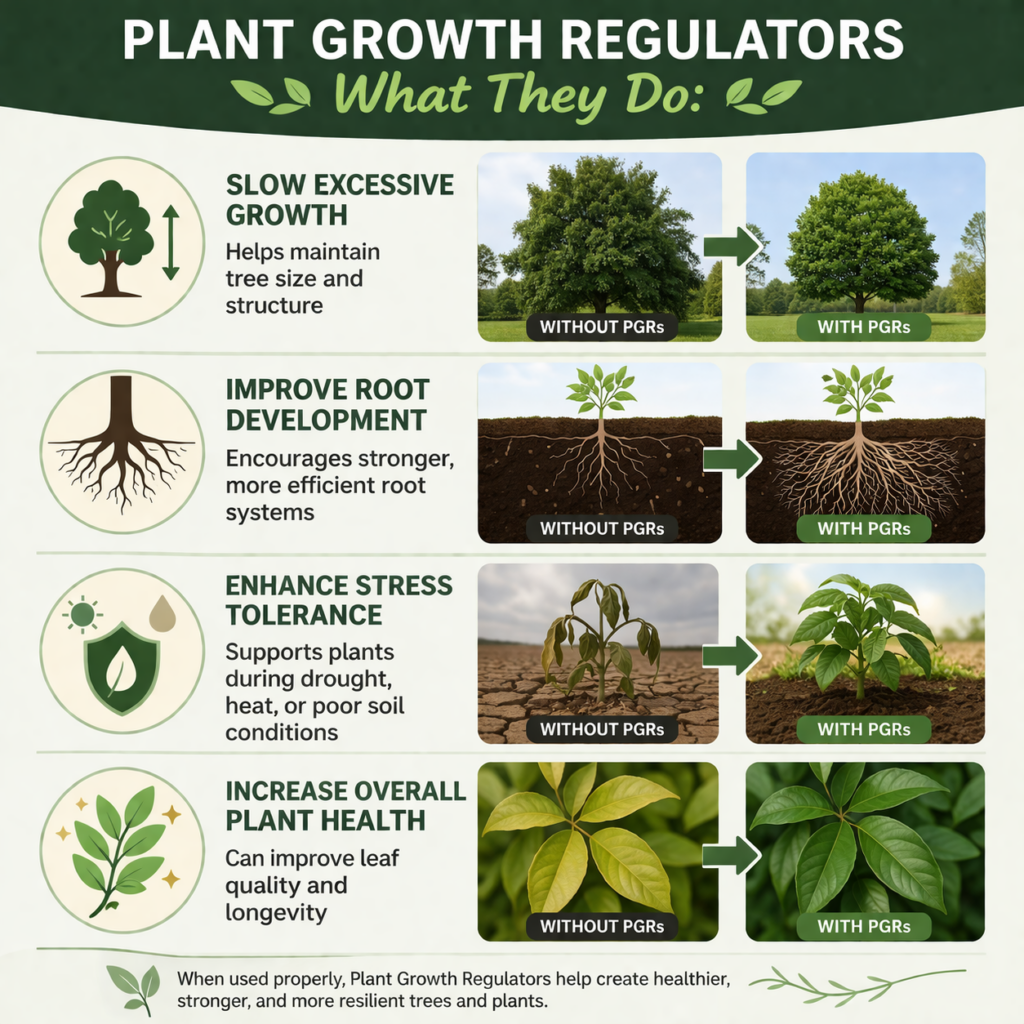
So what are Plant growth regulators (PGRs)? Think of them as a way to help a tree slow down and redirect energy — from fast, weak growth to roots, structure, and defense. PGRs are carefully formulated compounds, that mimic tree hormones, that influence how a plant grows, helping balance growth rather than stop it. When applied by a trained arborist, they can reduce excessive shoot growth while encouraging stronger root development, improved stress tolerance, and better overall tree health.
Instead of pushing a tree to grow bigger or faster, PGRs help it grow smarter, allocating energy where it’s most needed — especially in environments where trees face ongoing stress from compacted soils, limited rooting space, pruning, or nearby construction.
When are Plant Growth Regulators useful?
Plant growth regulators are most useful for trees experiencing chronic stress or imbalance. This often includes trees growing in compacted or urban soils, trees that require frequent pruning to manage size or clearance, and mature trees where preservation is the goal. PGRs can also be helpful when a tree is putting excessive energy into rapid shoot growth at the expense of roots and structural strength. In these cases, slowing top growth allows the tree to redirect energy below ground and into internal defense systems, supporting long-term stability and resilience.
What PGRs do not do
Plant growth regulators are not a cure-all. They do not replace proper pruning, correct poor planting practices, or compensate for severely compromised soil conditions on their own. PGRs do not “fix” declining trees, nor do they force a tree to grow in a way that is unnatural. They are one tool within a broader plant health care approach and are most effective when combined with sound arboricultural practices and realistic expectations about a tree’s condition and environment.
Why an arborist needs to be involved
The use of PGRs requires professional evaluation and precision. Different tree species respond differently, timing is critical, and dosage must be carefully calculated based on tree size, health, and site conditions. An arborist assesses whether a tree is a good candidate, determines the appropriate application, and ensures PGRs are used responsibly and ethically. Improper use can be ineffective at best and harmful at worst, which is why PGRs should only be applied as part of a thoughtful, science-based tree care plan.
The bigger picture
Plant growth regulators are about preservation, not control. They are used to support trees under stress, extend the functional life of mature trees, and reduce the need for unnecessary removals or aggressive pruning. This philosophy — prioritizing tree health, structural integrity, and long-term canopy retention — represents the fundamental basics of what Arboreal Solutions stands for. Contact us today to learn more.
Thank you for this information, it is very helpful!